Module 05 · History

People have always covered their walls.

A sourced timeline of murals and wall graphics, from hand stencils tens of thousands of years old to Seattle's two-mile SODO Track and today's printed wall films.

Updated Oct 2026 · 23 sources

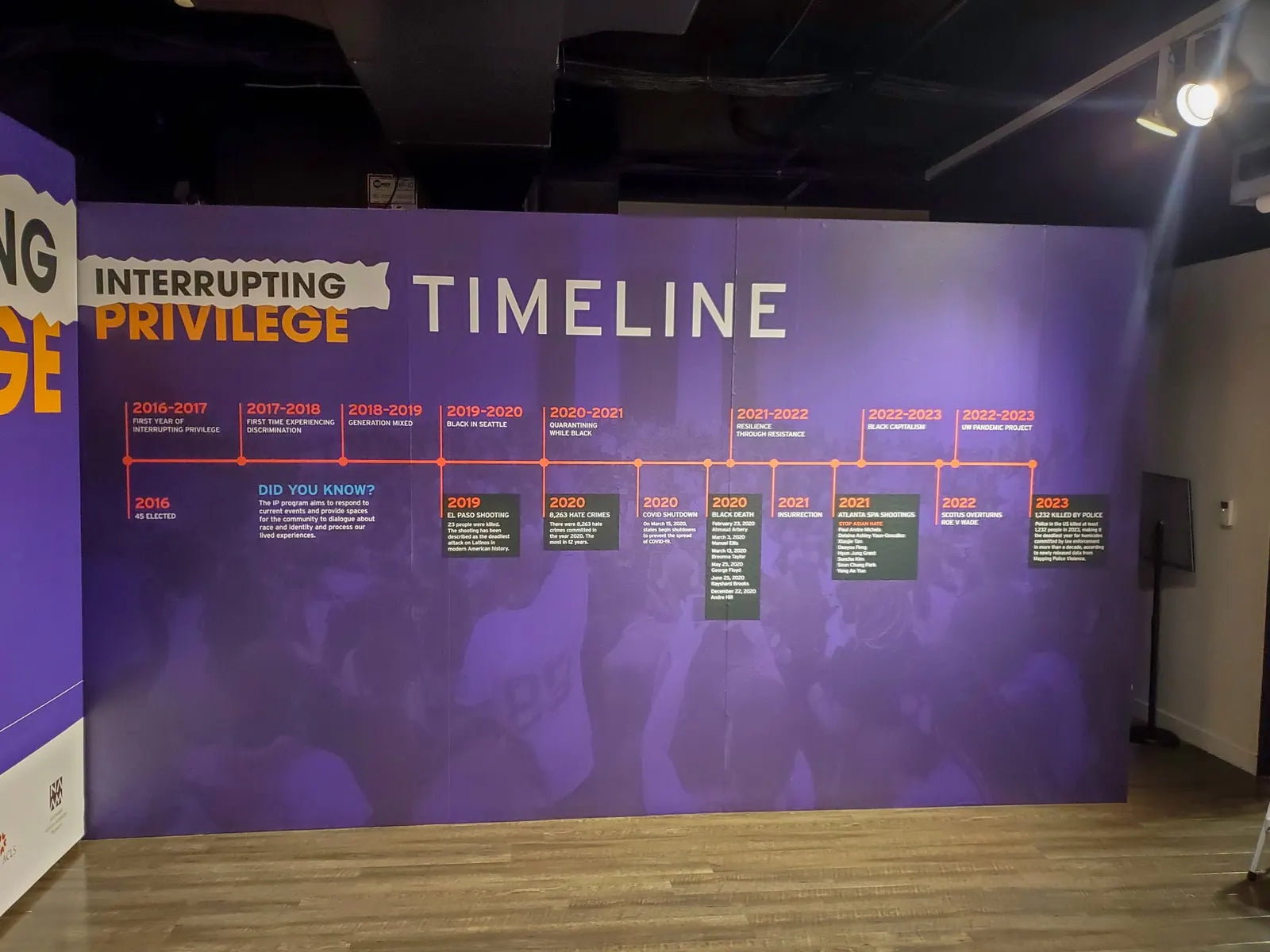
Floor-to-ceiling purple wall wrap printed with an Interrupting Privilege timeline of program milestones by year

Start here

What is a mural?

A mural is a large image made directly on a wall or ceiling, or made to be fixed to one. Over the centuries murals have been painted into wet plaster, set in glass tile, printed on paper and, with wide-format digital printing, printed on adhesive film.

Each new method made big images faster to produce and easier to change. The reason stayed the same: people want the walls around them to say something.

Every milestone below carries a status. Verified means we read the source and it says so. Often cited means the date is widely repeated and we have not confirmed it yet. Several sources are encyclopedia summaries, and we name them as such.

Timeline

21 milestones in wall art

From the oldest known painting to printed film made for brick. Seattle milestones are included where they happened.

  • VerifiedBacked by a document we could open
  • Often citedRepeated widely, not confirmed
  1. 67,800+ years agoVerified

    A hand stencil on Muna Island

    A hand stencil in Liang Metanduno cave on Muna Island, Indonesia, is reported to be at least 67,800 years old, the oldest known cave painting (Oktaviana et al., Nature, January 2026, as summarized by Wikipedia). Caves on nearby Sulawesi hold a pig-hunting scene dated to at least 51,200 years.

    SourceWikipedia: Cave painting (citing Nature, 2026) (opens in a new tab)
  2. About 35,000 to 30,000 years agoVerified

    Chauvet Cave, France

    More than 80 radiocarbon dates point to two periods of painting at Chauvet, about 35,000 and 30,000 years ago, though some researchers question those ages. It is among the best-preserved painted caves known.

    SourceWikipedia: Cave painting (opens in a new tab)

  3. c. 1350 BCEVerified

    The tomb-chapel of Nebamun, Egypt

    The plastered and painted walls of Nebamun's tomb-chapel at Thebes date to about 1350 BCE. Eleven fragments are in the British Museum, which bought them in 1821.

    SourceWikipedia: Tomb of Nebamun (opens in a new tab)

  4. 200 BC to 79 ADVerified

    Roman wall painting and the Four Styles

    Pompeian wall painting is split into four styles, from the marble-imitating First Style to the panoramic Fourth Style. Most were frescoes, painted into plaster while it was still drying. Vesuvius buried Pompeii in 79 AD and preserved them.

    SourceWikipedia: Roman wall painting (opens in a new tab)

  5. 1508 to 1512Verified

    Michelangelo's Sistine Chapel ceiling

    Commissioned by Pope Julius II, the ceiling fresco took four years and was unveiled on 31 October 1512. It measures about 35 by 14 meters and holds more than 300 figures.

    SourceWikipedia: Sistine Chapel ceiling (opens in a new tab)

  6. 1509Verified

    The earliest known English wallpaper

    The earliest known English wallpaper sample was printed on the back of a London proclamation dated 1509. Woodblock printing was the most common method before 1700, and England taxed wallpaper from 1712 until 1836.

    SourceWikipedia: Wallpaper (opens in a new tab)

  7. 1785 to 1813Verified

    Machines make wallpaper affordable

    Oberkampf built the first machine for printing colored tints on wallpaper in 1785. Louis-Nicolas Robert patented a continuous-paper machine in 1799, and by 1813 steam-powered presses in Britain made mass production and lower prices possible.

    SourceWikipedia: Wallpaper (opens in a new tab)

  8. 1797 to 1804Verified

    Scenic wallpaper panoramas

    Zuber et Cie, founded in 1797 and still operating, and Joseph Dufour et Cie printed room-sized scenic papers. Dufour's panoramic 'Sauvages de la Mer du Pacifique' followed in 1804. Zuber's 'Views of North America' (c. 1834) hangs in the White House Diplomatic Reception Room. These panoramas are early ancestors of today's printed photo murals.

    SourceWikipedia: Wallpaper (opens in a new tab)

  9. 1890s to 1960sVerified

    Wall dogs and ghost signs

    Hand-painted brick advertisements from the 1890s to the 1960s were most common before the Great Depression, and many are still visible. The painters were called wall dogs, and the faded survivors are known as ghost signs.

    SourceWikipedia: Ghost sign (opens in a new tab)

  10. 1922Verified

    Mexican muralism

    After the Mexican Revolution, the government under Education Minister José Vasconcelos funded public murals. Diego Rivera's first government-backed mural, 'Creation', went into the National Preparatory School in 1922. Rivera, José Clemente Orozco and David Alfaro Siqueiros became known as the Big Three.

    SourceWikipedia: Mexican muralism (opens in a new tab)

  11. 1935 to 1943Verified

    The WPA Federal Art Project

    Formed on August 29, 1935 as a relief program, the Federal Art Project ran until June 30, 1943. Sources cite as many as 10,000 artists and more than 200,000 works; American Heritage puts the total near 400,000, counting prints and posters.

    SourceWikipedia: Federal Art Project (opens in a new tab)

  12. 1959Verified

    Philadelphia's percent-for-art ordinance

    Philadelphia adopted the first percent-for-art ordinance in a U.S. city, setting aside a share of capital project funds for public art. Seattle and other cities followed.

    SourceWikipedia: Percent for art (opens in a new tab)

  13. 1962Verified

    Horiuchi's Seattle Mural

    Paul Horiuchi's Seattle Mural was commissioned for the 1962 Century 21 Exposition and sits at the Mural Amphitheatre at Seattle Center. The city's collection lists it as Venetian glass and grout on concrete, with the glass tiles made in Venice and shipped to Seattle. It was a gift to the city from the Century 21 Corporation.

    SourceSeattle Office of Arts & Culture collection: Seattle Mural (opens in a new tab)

  14. 1967 to 1984Often cited

    The community mural movement

    The community mural movement is usually traced to Chicago's Wall of Respect (1967), followed by Chicano murals in the Southwest, the Great Wall of Los Angeles (begun 1976) and Philadelphia's Mural Arts Program (1984). These dates are widely repeated, and we have not yet verified each one.

    SourceWikipedia: Wall of Respect (opens in a new tab)

  15. 1973Verified

    Seattle's 1 Percent for Art

    On May 21, 1973, the Seattle City Council approved Ordinance 102210, setting aside 1 percent of capital improvement project funds for art. HistoryLink is clear that Seattle was not the first city to pass such a law, though it was one of the earliest. King County adopted a similar ordinance the same year and was the first county in the nation to do so.

    SourceHistoryLink Essay 10645 (opens in a new tab)

  16. 1991 to 1993Verified

    The first bus wraps

    Contra Vision produced what is called the world's first total bus wrap in New Zealand in 1991, using see-through window graphics. The first digitally printed vehicle wrap is thought to have been made for a Crystal Pepsi bus in 1993. The same print-and-apply idea now covers walls.

    SourceWikipedia: Vehicle vinyl wrap (opens in a new tab)

  17. 1994 to 2005Verified

    Wide-format inkjet goes mainstream

    Scitex Vision began as Idanit Technologies in 1994, was acquired by Scitex in 1998 and was bought by HP in 2005 to become HP Scitex. Deals like these pulled industrial wide-format inkjet into the sign and graphics trade.

    SourceWikipedia: Scitex Vision (opens in a new tab)

  18. 2013Verified

    3M DI-NOC reaches North America

    Designtex announced it would distribute 3M DI-NOC Architectural Finishes in North America; Interior Design reported the film had previously been available only in Japan. The collection launched in the U.S. on December 1, 2013, with more than 500 patterns, installed with a squeegee, heat gun and blade. The DI-NOC name goes back to a Cleveland company founded in 1923 that 3M acquired in 1962 (Curbside Classic).

    SourceInterior Design, December 2013 (opens in a new tab)

  19. 2016 to 2018Verified

    SODO Track

    A 2016 pilot had 12 artists paint nine murals along Seattle's SODO busway. By August 2018 the corridor held 50 murals by 62 artists along two miles. 4Culture, which led the project with the SODO Business Improvement Area and Urban Artworks, describes it as the world's longest contiguous corridor of street art.

    SourceCascade PBS (Crosscut), August 2018 (opens in a new tab)

  20. 2017Verified

    Printable film made for textured walls

    3M's Scotchcal IJ8624 is a printable film for moderately textured surfaces such as concrete block, brick, industrial stucco and tile. The product bulletin on file is Revision E, dated September 2017; we did not find a launch year. 3M gives an expected indoor life of 2 years on textured surfaces and says that is not a warranted period.

    Source3M IJ8624 product bulletin, Rev. E (opens in a new tab)

Did you know?

Nine facts worth repeating

Each one is drawn from the sources in the timeline above.

  • Verified

    Prehistory

    The oldest known painting is a hand

    A hand stencil on Muna Island, Indonesia, is reported to be at least 67,800 years old.

  • Verified

    Renaissance

    Four years on one ceiling

    Michelangelo painted the Sistine Chapel ceiling from 1508 to 1512, with more than 300 figures.

  • Verified

    Wallpaper

    England taxed wallpaper

    From 1712 until 1836. The earliest known English wallpaper was printed on the back of a 1509 proclamation.

  • Verified

    Wallpaper

    Scenic paper in the White House

    Zuber, founded in 1797, still makes scenic wallpaper. Its 'Views of North America' (c. 1834) hangs in the Diplomatic Reception Room.

  • Verified

    Muralism

    One survivor in Los Angeles

    Siqueiros painted three murals in Los Angeles in 1932. Only 'America Tropical' was not painted over.

  • Verified

    Seattle

    One of the earliest cities

    Seattle's 1 Percent for Art passed on May 21, 1973. Philadelphia was first among U.S. cities in 1959; King County's 1973 ordinance was the first by a U.S. county.

  • Verified

    Seattle

    Two miles of murals

    By 2018 the SODO Track held 50 murals by 62 artists, which 4Culture calls the world's longest contiguous corridor of street art.

  • Verified

    Seattle

    Glass from Venice

    The tiles in Paul Horiuchi's Seattle Mural were made in Venice and shipped to Seattle for the 1962 World's Fair.

  • Verified

    Vinyl

    A soda bus started digital wraps

    The first digitally printed vehicle wrap is thought to be a 1993 Crystal Pepsi bus.

Seattle murals

Seattle's mural story

Three Seattle landmarks sit on this timeline. Paul Horiuchi's Seattle Mural was made for the 1962 World's Fair and sits at the Mural Amphitheatre at Seattle Center, built from Venetian glass tiles set in grout on concrete. Published dimensions disagree, so we leave the size out.

In 1973 Seattle passed its 1 Percent for Art ordinance, which sets aside 1 percent of capital improvement project funds for art. Seattle was not first; Philadelphia led in 1959. It was one of the earliest cities, and King County passed the first county ordinance the same year.

The SODO Track began as a 2016 pilot along the SODO busway and grew to 50 murals by 62 artists over two miles by 2018. 4Culture led it with the SODO Business Improvement Area and Urban Artworks.

Ardor Printing works north of the city in Snohomish and installs printed walls across King and Snohomish counties. Its Seattle walls include a line-art brewery mural for Reuben's Brews and exhibit walls at the Northwest African American Museum.

What comes next

Where wall graphics are going

The next chapter is already showing up on data sheets. Here is what the sources show today.

  • Cleaner indoor air: water-based latex inks and PVC-free films now carry UL GREENGUARD Gold certification (HP Latex inks; 3M Envision 48C film).
  • Film that handles texture: products like 3M IJ8624 put printed graphics on brick, block and industrial stucco, applied with heat.
  • Finishes that look like materials: architectural films such as 3M DI-NOC now come in more than 900 designs (3M US), and Avery Dennison launched its Rehlm architectural finishes in September 2026 (trade press).
  • Recycled content: the base film of 3M's DI-NOC E-Series RC is 80% post-consumer recycled polyester.
  • Proof before print: a digital mock-up shows the design on a photo of your own wall before anything prints. Ardor's process includes this proof step.

Our view

Walls are starting to behave like signage

This is opinion, not a measured trend. Printed film makes a wall easier to change than paint or plaster, so more spaces will treat walls the way they treat signs: updated when the brand, the mission or the season changes. The cave painters would recognize the impulse.

Projects

History on Ardor's walls

Timeline and exhibit walls Ardor has printed and installed.

See every project

2 projects

  • Floor-to-ceiling purple wall wrap printed with an Interrupting Privilege timeline of program milestones by year
    Exhibits & Museums

    Program Timeline Wall

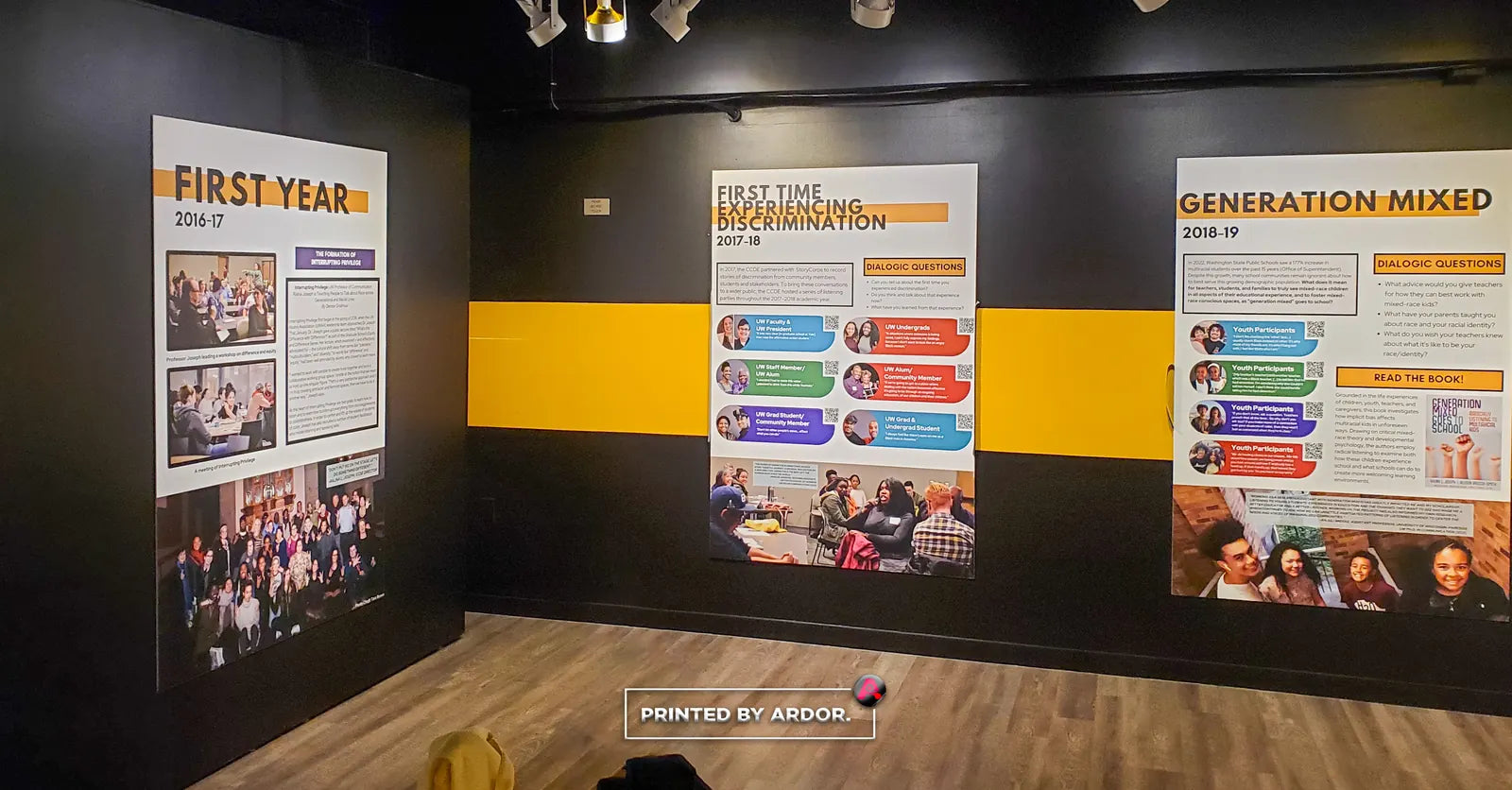
  • Museum exhibit wall with black and yellow wall wrap and large printed history panels titled First Year and Generation Mixed
    Exhibits & Museums

    Museum Exhibit Walls and History Panels

FAQ

Frequently asked questions

What is the history of murals?

Murals began with cave paintings tens of thousands of years ago, moved into Egyptian tombs and Roman villas as fresco, filled Renaissance ceilings like the Sistine Chapel, went public with Mexican muralism and the WPA, and now include printed wall wraps.

What is the oldest known mural?

The oldest known cave painting is a hand stencil on Muna Island, Indonesia, reported to be at least 67,800 years old (Nature, 2026, via Wikipedia). Chauvet and Lascaux in France are about 30,000 to 35,000 and 17,000 years old.

What is the difference between a fresco and a mural?

A fresco is one way to make a mural: pigment painted into plaster while it is still drying, as at Pompeii and in the Sistine Chapel. Mural is the broader term for any large image on a wall or ceiling.

When did printed wall wraps begin?

The tools arrived in the 1990s. The first digitally printed vehicle wrap is thought to date to 1993, and wide-format inkjet went mainstream through deals between 1994 and 2005. We have not found a reliable date for the first printed wall wrap.

Was Seattle the first city with a percent-for-art law?

No. Philadelphia was first among U.S. cities in 1959. Seattle passed its 1 Percent for Art ordinance on May 21, 1973, one of the earliest, and King County's 1973 ordinance was the first by a U.S. county.

What is the SODO Track?

A mural corridor along Seattle's SODO busway. It began with a 2016 pilot, and by August 2018 it had 50 murals by 62 artists along two miles. 4Culture calls it the world's longest contiguous corridor of street art.

Where is the Seattle Mural?

Paul Horiuchi's Seattle Mural is at the Mural Amphitheatre at Seattle Center. It was made for the 1962 World's Fair from Venetian glass tiles set in grout on concrete.

Sources

  1. [1] Wikipedia, Cave painting (citing Oktaviana et al., Nature, 2026) (opens in a new tab)
  2. [2] Wikipedia, Tomb of Nebamun (opens in a new tab)
  3. [3] Wikipedia, Roman wall painting (opens in a new tab)
  4. [4] Wikipedia, Sistine Chapel ceiling (opens in a new tab)
  5. [5] Wikipedia, Wallpaper (opens in a new tab)
  6. [6] Wikipedia, Ghost sign (opens in a new tab)
  7. [7] Wikipedia, Mexican muralism (opens in a new tab)
  8. [8] Wikipedia, Federal Art Project (opens in a new tab)
  9. [9] Wikipedia, Percent for art (opens in a new tab)
  10. [10] Seattle Office of Arts & Culture collection, Seattle Mural (Paul Horiuchi) (opens in a new tab)
  11. [11] Wikipedia, Wall of Respect (opens in a new tab)
  12. [12] HistoryLink, Seattle City Council approves 1 Percent for Art (Essay 10645) (opens in a new tab)
  13. [13] Wikipedia, Vehicle vinyl wrap (opens in a new tab)
  14. [14] Wikipedia, Scitex Vision (opens in a new tab)
  15. [15] Interior Design, Designtex markets 3M DI-NOC Architectural Finishes (2013) (opens in a new tab)
  16. [16] Curbside Classic, The History of Di-Noc (opens in a new tab)
  17. [17] Cascade PBS (Crosscut), Seattle's SODO Track mural corridor (August 2018) (opens in a new tab)
  18. [18] 3M, Scotchcal IJ8624 product bulletin (Rev. E, Sept 2017) (opens in a new tab)
  19. [19] 3M, Architectural Finishes for Architectural Design (US) (opens in a new tab)
  20. [20] 3M, DI-NOC Architectural Finishes technical data sheet (Rev. S, 2024) (opens in a new tab)
  21. [21] Digital Output, Avery Dennison debuts Rehlm Architectural Finishes (Sept 2026) (opens in a new tab)
  22. [22] 3M, Envision Print Film 48C (opens in a new tab)
  23. [23] HP, Latex Inks sustainability and certifications page (opens in a new tab)

Free on-site estimates · Ardor Printing

Putyourstoryon thewall

Timelines, mission walls and photo murals for offices, churches, schools and museums. Ardor's free on-site estimate starts with a measure and a look at your wall. Call (425) 629-0796, Monday to Friday, 7am to 5pm.

Handled by Ardor Printing → ardorprinting.com12531 Old Snohomish Monroe Rd., Snohomish, WA 98290