Module 06 · Glossary
Speak fluent wall graphics.
Forty terms you will hear from installers, data sheets and fire marshals, defined in plain English with the source behind each one.
How to use this
Wall graphics, defined
Wall graphics is the umbrella term for printed or cut images applied to interior and exterior walls: full wall wraps, murals, logos, lettering and wayfinding. The trade has its own vocabulary, and data sheets assume you know it.
Terms run A to Z. The source column names the document behind each definition, so you can check it yourself. A few window-film terms are included because the same crews and data sheets cover glass.
Wall Academy · Glossary
40 wall graphics terms, A to Z
Search, or jump to a letter. Each definition names the document behind it.
40 terms
Terms starting with A
- Adhesion promoter
A liquid primer wiped onto edges, corners, seams and stretched areas so film grips harder where it is most likely to lift. 3M names Tape Primer 94 and its water-based DI-NOC WP-2000.
Source: 3M DI-NOC technical data sheet
- Adhesion test (strip test)
A strip of film applied to the actual wall and pulled after a set dwell to check bond strength. 3M uses a 15-minute dwell and measures the pull in grams; Avery leaves a strip on for 2 to 3 days.
Source: 3M Instruction Bulletin; Avery IB 1.6
- Air egress (air release)
Tiny channels in the adhesive that let trapped air escape, so bubbles squeegee out. Avery Easy Apply and 3M Comply are examples.
Source: Avery MPI 2903 PDS; 3M Envision 48C
- Architectural film
A thick decorative self-adhesive film printed and embossed to look like wood, stone, metal, leather or solid color, used to reface walls, doors, columns and cabinets. 3M DI-NOC, LX Hausys BENIF and Avery Dennison Rehlm are examples.
Source: 3M DI-NOC product page; LX Hausys; Digital Output
- ASTM E84
The standard fire test for surface burning of building materials, also published as UL 723. It reports a flame spread index and a smoke-developed index, which the building code turns into Class A, B or C.
Source: 2021 Seattle Building Code, ch. 8
- ASTM F793
A standard classification of wallcovering by durability and use. HP cites it for the Type II rating of its PVC-free wall paper.
Source: HP wall paper spec sheet
Terms starting with C
- Calendered film
Vinyl produced by rolling it into sheets. It is thicker and lower in cost than cast film and can shrink with heat. Avery recommends it for smooth walls.
Source: Avery IB 1.6
- Cast film
Vinyl cast as a liquid and cured into a thin, conformable sheet. Avery recommends it for slightly textured and cinder-block walls, worked in with heat.
Source: Avery IB 1.6
- Class A, B and C finishes
Interior finish ratings based on ASTM E84 flame spread: A is 0 to 25, B is 26 to 75 and C is 76 to 200, all with smoke developed of 0 to 450. The class required depends on occupancy, wall location and sprinklers.
Source: 2021 Seattle Building Code, ch. 8
- Controltac and Comply
3M adhesive technologies. Controltac lets a panel be repositioned during install. Comply adds air-release channels for bubble-free application.
Source: 3M Envision 48C product page
Terms starting with D
- DI-NOC
3M's line of architectural finish films: about 8 mil of vinyl with a permanent pressure-sensitive adhesive, in more than 900 designs (3M US). Standard DI-NOC is rated for vertical interior use; the EX and EXR series are made for exteriors.
Source: 3M DI-NOC technical data sheets
- Dry application
Applying wall graphics without any application fluid. Avery specifies dry application only for its wall films.
Source: Avery IB 1.6
- Dry-erase laminate
A clear overlaminate with a hard coat that wipes clean of dry-erase marker. Drytac WipeErase Clear is one example; Arlon says its standard overlaminates are not designed for dry-erase.
Source: Large Format Review; Arlon
- Dwell time
How long a film or test strip stays on a surface before it is tested or removed. 3M's wall test uses 15 minutes; its textured-wall test uses one week.
Source: 3M Instruction Bulletin
Terms starting with F
- Flame spread index (FSI) and smoke-developed index (SDI)
The two numbers an ASTM E84 test produces. Lower is better for both. Class A requires FSI 0 to 25 and SDI 0 to 450.
Source: 2021 Seattle Building Code, ch. 8
Terms starting with G
- GREENGUARD Gold
A UL certification for low chemical emissions into indoor air, tested under UL 2818 and stricter than basic GREENGUARD. HP cites it for its Latex inks and PVC-free wall paper; 3M cites it for Envision 48C film.
Source: HP Latex sustainability page; HP wall paper spec sheet; 3M Envision 48C
Terms starting with H
- Hi-Tack adhesive
An aggressive adhesive made to grip textured surfaces. Avery's MPI 2636 textured film line uses it.
Source: Avery MPI 2600 product page
Terms starting with I
- Ink load
The total amount of ink laid down, given as a percentage. Too much increases shrinkage and initial adhesion. Avery flags loads above 250% on MPI 2600 and sets 270% as the maximum on MPI 2903.
Source: Avery MPI 2600 and MPI 2903 PDS
- IPA (isopropyl alcohol)
The standard cleaning solvent before film goes on a wall. 3M recommends wiping twice with 70% IPA and 30% water, then waiting about 10 minutes for the wall to return to normal temperature.
Source: 3M Instruction Bulletin; SignShop
Terms starting with L
- Latex ink
Water-based inkjet ink used for indoor graphics. HP states its Latex inks are UL GREENGUARD Gold certified and dry instantly for immediate lamination and installation.
Source: HP Latex sustainability page; HP Latex 730/830 page
- Low-VOC and zero-VOC paint
Paints with reduced solvent content, good for indoor air. 3M notes that film is less likely to adhere to them, so plan for an adhesion test.
Source: 3M Instruction Bulletin
Terms starting with M
- Mosaic Graphic Technique
3M's method of splitting a graphic into segments so it fits tile, brick or block with grout lines deeper than 1/8 inch.
Source: 3M Instruction Bulletin
Terms starting with O
- Outgassing
Solvents or gases escaping from fresh paint, new drywall or undried ink. Trapped under film, they cause bubbles and lifting, which is why paint and prints need time to cure.
Source: Avery IB 1.6; Mactac; ORAFOL ORAJET 3628 TDS
- Overlaminate
A clear protective film applied over a printed graphic. It sets the sheen (gloss, luster or matte) and adds resistance to abrasion and cleaning.
Source: Avery DOL 3060/3070/3080 PDS
Terms starting with P
- Peel adhesion
The force needed to peel film from a standard test surface such as stainless steel, given in lb/in or N/25 mm. Avery's removable wall film reaches 1.5 lb/in at 24 hours; the permanent version reaches 4.0 lb/in.
Source: Avery MPI 2600 PDS
- Perforated (one-way vision) film
Printed film with a hole pattern, so the graphic shows from outside while people inside can see out. Avery's 50/50 version has 50% open area. Rule of thumb: the effect needs the outside to be brighter than the inside.
Source: Avery MPI 2528 (distributor listing); Contra Vision
- Primer and sealer
A coat applied before graphics to seal porous or problem surfaces so film has something sound to grip. 3M lists options such as ZINSSER Bulls Eye 1-2-3 and GARDZ, and 3M and Mactac both ask for primer and paint from one maker.
Source: 3M Instruction Bulletin; Mactac
- PVC-free film
Graphic film made without polyvinyl chloride. 3M Envision 48C is a 3 mil non-PVC film, and HP makes a PVC-free printable wall paper.
Source: 3M Envision 48C; HP wall paper spec sheet
Terms starting with R
- Refacing
Covering an existing door, cabinet, column, wall or elevator panel with finish film to change its look without replacing it. 3M describes less downtime, noise and disruption. Film cannot fix a damaged, swollen or moisture-affected surface.
Source: 3M DI-NOC product page; 3M DI-NOC prep guides
- Removable and permanent adhesive
Removable adhesive is designed to peel off, though Avery does not warrant wall damage on removal. Permanent adhesive is made to stay and damages paint when removed.
Source: Avery MPI 2600 PDS; Avery IB 1.6
- Rivet brush
A stiff-bristle brush used to push film into texture and finish edges. Avery specifies a 75 mm brush; 3M's version is the RBA-1.
Source: Avery IB 1.6; 3M
- Roll width
The width of the film roll, which sets the widest panel that can print in one piece. Ardor's wall film runs on 54-inch rolls, so wider walls are printed in overlapping panels.
Source: Ardor production specs
Terms starting with S
- Seam (overlap and double cut)
Where two panels meet. Avery calls for an overlap of at least 0.5 inch. Mactac also describes cutting through both overlapping layers and removing the off-cuts so the panels butt together.
Source: Avery IB 1.6; Mactac
- Squeegee (felt-edge)
The hand tool used to press film onto the wall. Mactac says to use a felt squeegee on its wall media, and Avery says to pull it across the film rather than push, which stretches the film.
Source: Mactac; Avery IB 1.6
Terms starting with T
- Textured-wall film
Film made to conform to brick, block or stucco when heated. 3M IJ8624 is applied with a TSA-4 applicator and a heat gun and paired with 8524 laminate.
Source: 3M IJ8624; 3M Instruction Bulletin
- Type I, II and III wallcovering
Commercial vinyl wallcovering grades under WA-101, set by minimum weight (7, 13 and 22 oz/yd²) and scrub cycles (200, 300 and 500). Fire rating is tested separately.
Source: Wallcovering Association WA-101
Terms starting with V
- VLT and VLR
Visible light transmittance and visible light reflectance: how much light a glass-and-film system lets through and bounces back. Used to compare window films.
Source: 3M window film data sheets
Terms starting with W
- Wall wrap
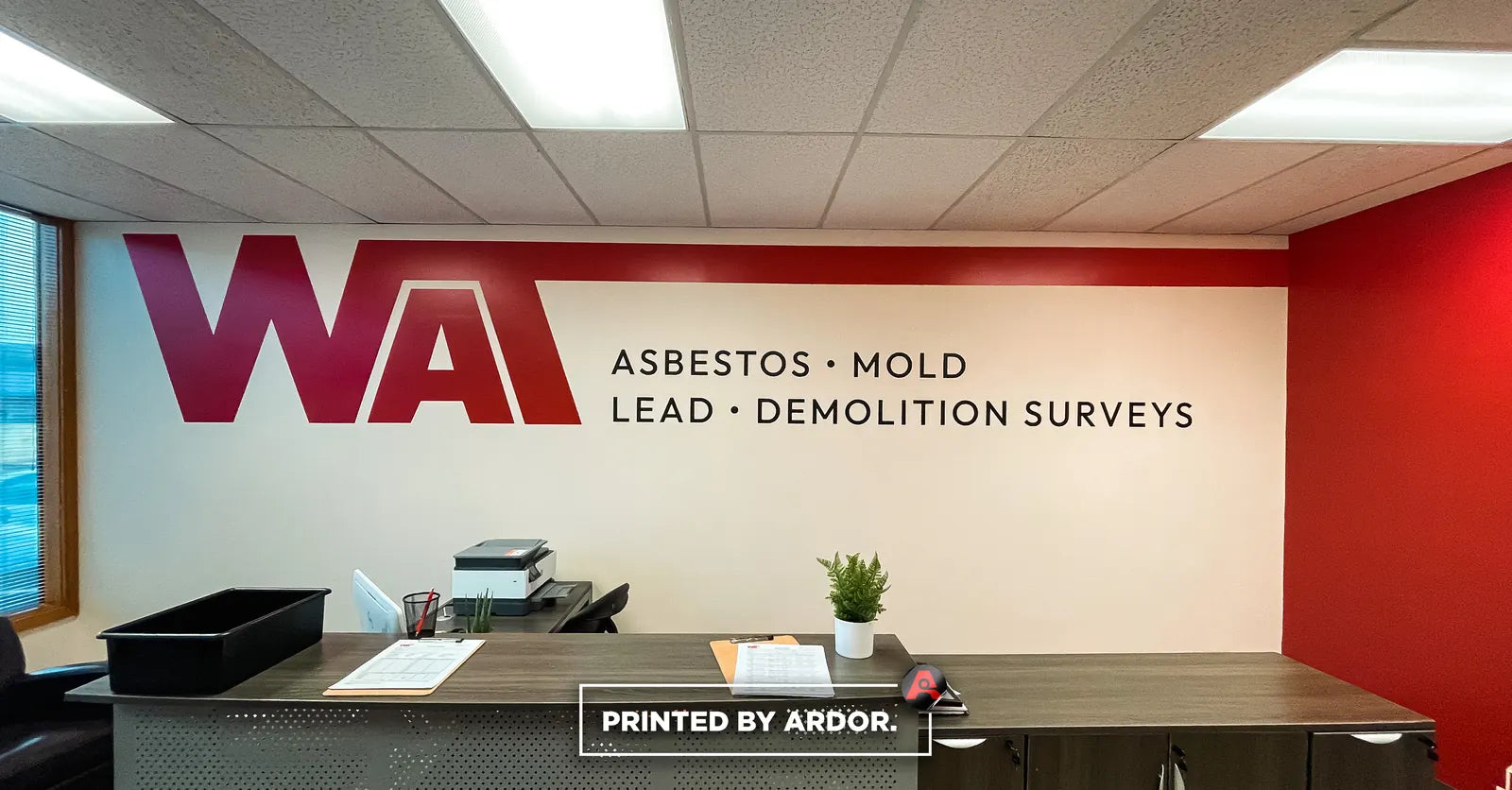
A large printed graphic on adhesive wall film, usually laminated and installed in panels directly on a wall. It can cover a full wall, part of one, or wrap around doors and windows.
Source: Ardor Printing
- Wallcovering
A finish material hung on interior walls, from traditional wallpaper to commercial vinyl. Printed wallcovering is usually hung with paste, unlike self-adhesive wall film.
Source: WA-101; HP wall paper spec sheet
- Wet application
Applying film over a slip solution so it can be positioned, then squeegeeing the solution out. It is standard for window films. Wall films go on dry.
Source: 3M FASARA and Dichroic bulletins; Avery IB 1.6
No terms match your search. Try a shorter word, or .
Keep learning
See the terms in context
The modules put these words to work on real walls.
 Process
Module 01
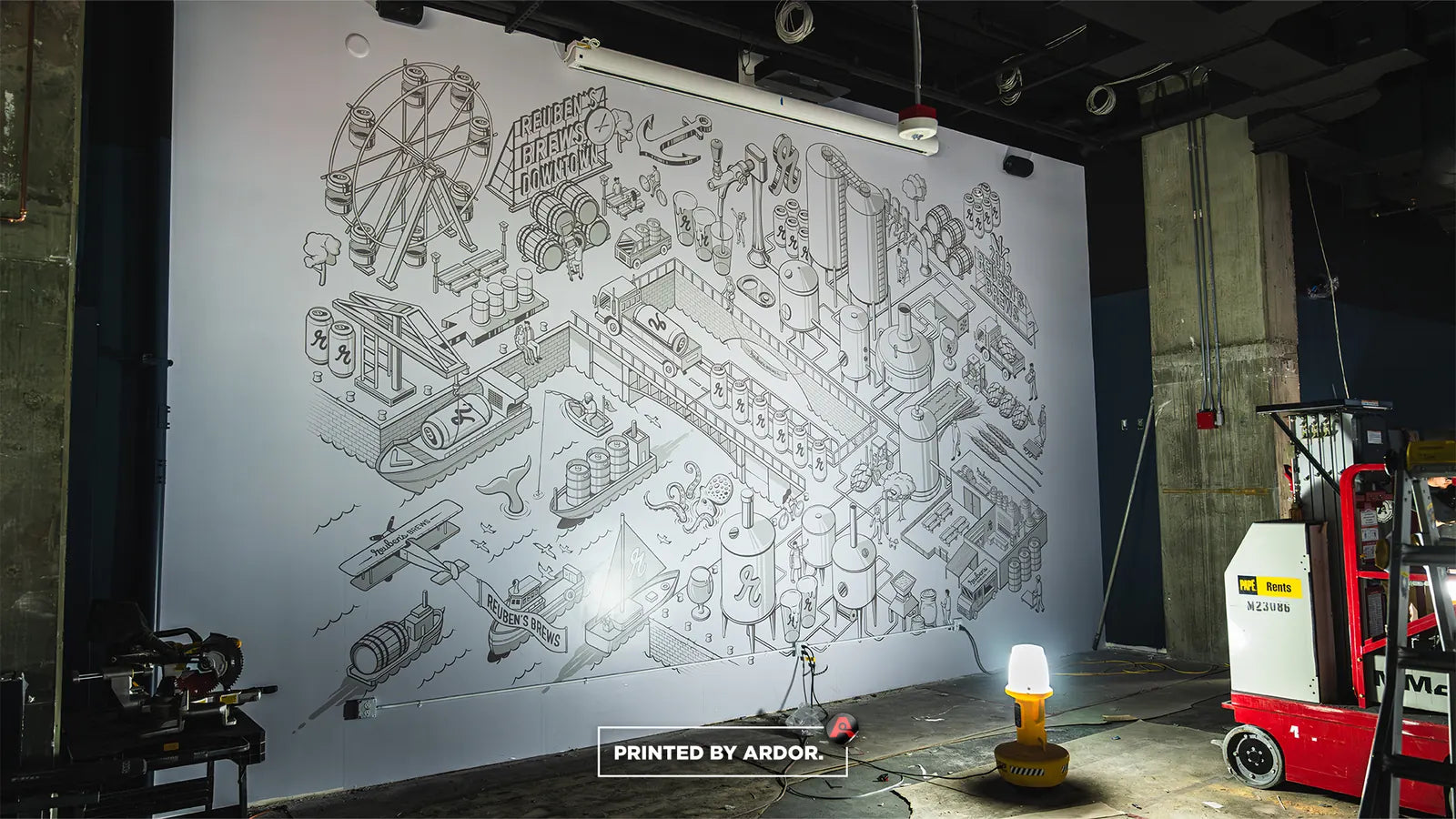
How wall wraps are made
Overlaminate, ink load, outgassing and seams, in the order they happen.
 Prep
PrepModule 02
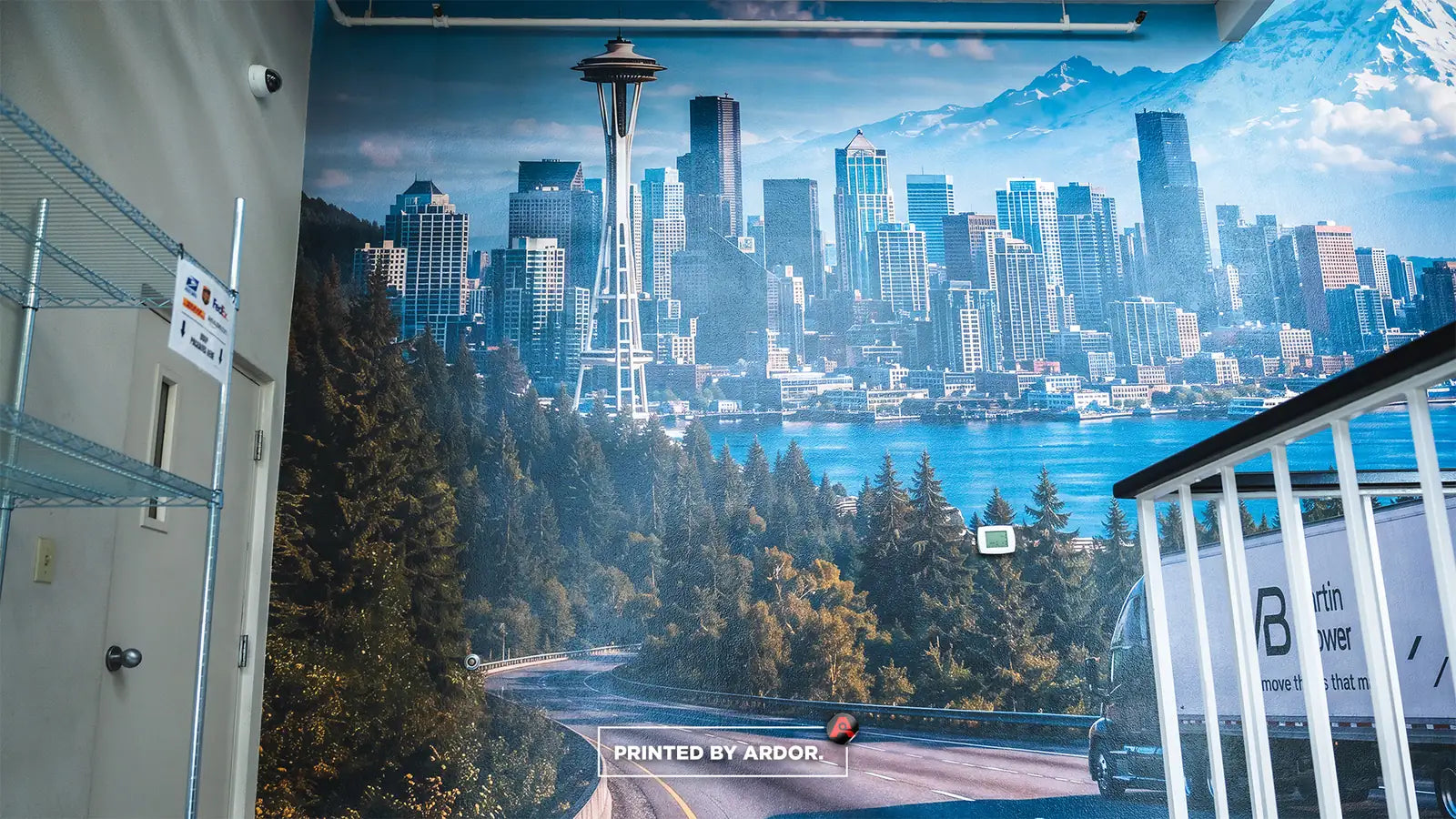
Wall surfaces guide
Adhesion tests, primers, low-VOC paint and the Mosaic technique on real surfaces.
 Materials
Module 03
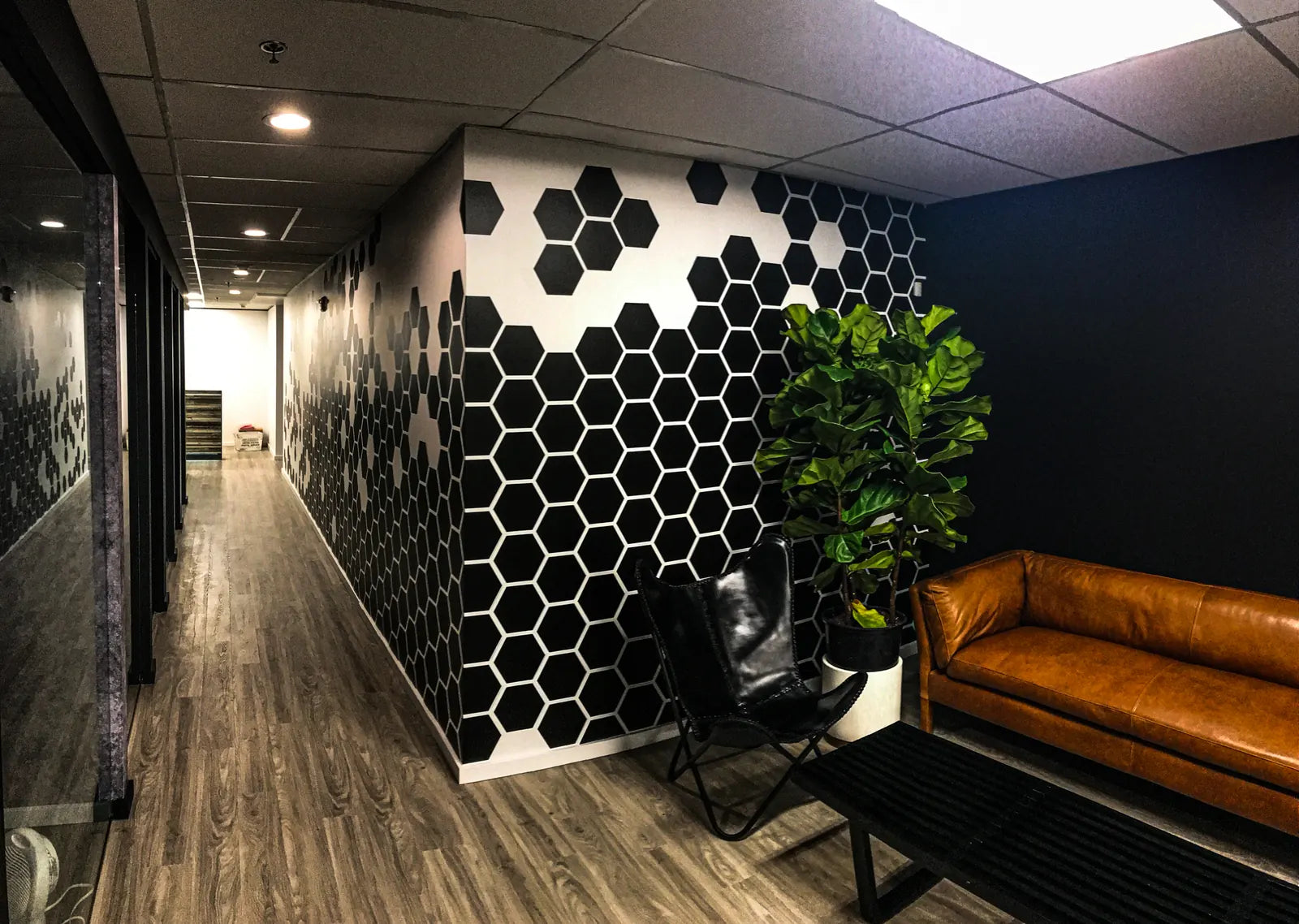
Wall film types and laminates
Cast, calendered, removable, permanent, Class A and GREENGUARD Gold, compared.
FAQ
Frequently asked questions
What are wall graphics?
Printed or cut images applied to walls: full wall wraps, murals, logos, lettering and wayfinding. Most are printed on adhesive wall film and protected with a clear laminate.
What is the difference between cast and calendered vinyl?
Calendered vinyl is rolled into sheets; it is thicker, costs less and suits smooth walls. Cast vinyl is poured as a liquid and cured; it is thinner and more conformable, so Avery recommends it for lightly textured and block walls.
What does Class A mean for wall graphics?
Class A is the best interior finish rating under ASTM E84: flame spread of 0 to 25 and smoke developed of 0 to 450. Many wall films publish a Class A result, and the building code sets which class a space needs.
What is outgassing?
Solvents or gases escaping from fresh paint, new drywall or undried ink. If film traps them, it bubbles or lifts, which is why paint must cure and solvent prints must dry before install.
What is refacing?
Covering an existing surface, like a door, cabinet or column, with architectural finish film to change its look without replacing it. It works only on sound, sealed surfaces.
Is a wall decal the same as a wall wrap?
Both use adhesive film. In common use, a decal is a smaller cut or printed piece, and a wall wrap covers a large area or a whole wall in panels (rule of thumb).
Sources
- [1] 3M, Instruction Bulletin: Application, Substrate Selection and Preparation (opens in a new tab)
- [2] 3M, DI-NOC Architectural Finishes technical data sheet (Rev. S, 2024) (opens in a new tab)
- [3] 3M, DI-NOC Architectural Finishes installation guide (opens in a new tab)
- [4] 3M, DI-NOC Architectural Finishes product page (opens in a new tab)
- [5] 3M, Architectural Finishes for Architectural Design (US) (opens in a new tab)
- [6] 3M, Envision Print Film 48C (opens in a new tab)
- [7] 3M, Scotchcal IJ8624 Graphic Film for Textured Surfaces (opens in a new tab)
- [8] 3M, FASARA Glass Finishes Sagano product page (opens in a new tab)
- [9] 3M, Dichroic Glass Finishes product bulletin (opens in a new tab)
- [10] Avery Dennison, MPI 2600 Series Wall Film product data sheet (Rev. 17) (opens in a new tab)
- [11] Avery Dennison, MPI 2600 Wall Film Series product page (opens in a new tab)
- [12] Avery Dennison, Instructional Bulletin 1.6: Interior Wall Graphics (opens in a new tab)
- [13] Avery Dennison, MPI 2903 Easy Apply data sheet (opens in a new tab)
- [14] Avery Dennison, DOL 3060/3070/3080 overlaminate data sheet (opens in a new tab)
- [15] Imaging Spectrum, Avery MPI 2528 Perforated Film 50/50 (distributor listing) (opens in a new tab)
- [16] Contra Vision, Printable Perforated Window Film (opens in a new tab)
- [17] ORAFOL Americas, ORAJET 3628 Wall Art Digital technical data sheet (opens in a new tab)
- [18] HP, Latex Inks sustainability and certifications page (opens in a new tab)
- [19] HP, Latex 730 and 830 Printer Series page (instant-dry Latex inks) (opens in a new tab)
- [20] HP, PVC-free Durable Smooth Wall Paper spec sheet (8/29/23) (opens in a new tab)
- [21] The Wallcovering Association, WA-101 Quality Standard (2025) (opens in a new tab)
- [22] Mactac, Deco Media Application Guide (opens in a new tab)
- [23] SignShop, 3M Issues New Wall Preparation Recommendations (opens in a new tab)
- [24] Large Format Review, Drytac WipeErase Clear announcement (opens in a new tab)
- [25] Arlon Graphics, overlaminates and dry-erase use (opens in a new tab)
- [26] LX Hausys, What is BENIF Architectural Film (opens in a new tab)
- [27] Digital Output, Avery Dennison debuts Rehlm Architectural Finishes (Sept 2026) (opens in a new tab)
- [28] City of Seattle SDCI, 2021 Seattle Building Code, Chapter 8: Interior Finishes (opens in a new tab)
- [29] Ardor Printing, Wall Wraps and Murals (opens in a new tab)
Free on-site estimates · Ardor Printing
Ratherhearitin person?
Ardor's crew will walk your wall with you, explain the film and quote it, free. Call (425) 629-0796, Monday to Friday, 7am to 5pm, or request a quote online.